What it does
The register covers the normal day of whoever looks after the kit. Almost all of it is on the free tier; the few Team features are marked.
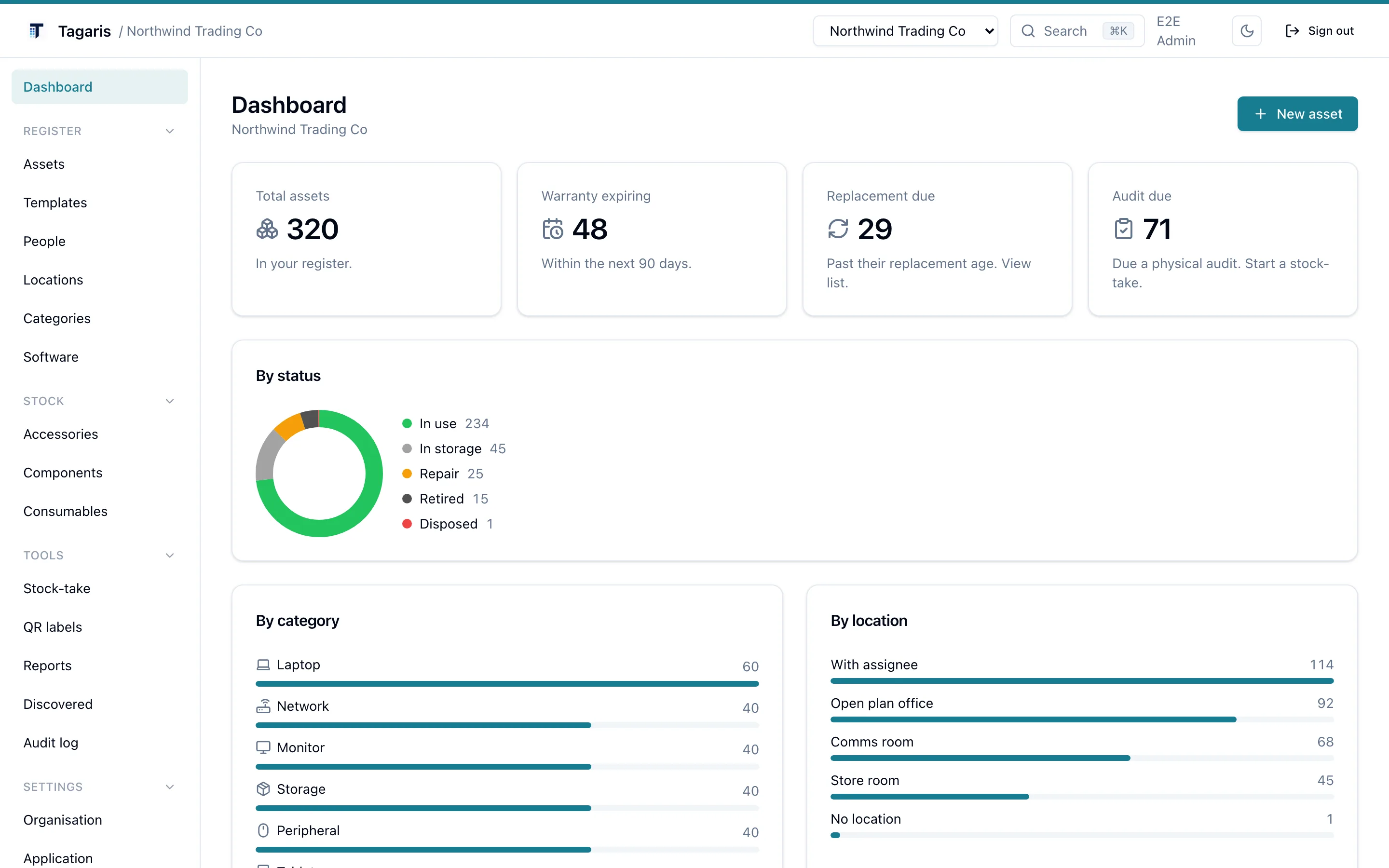
One dashboard for the whole estate
Total assets, warranties expiring in the next 90 days, and anything past its replacement age, on one screen when you sign in.
- Counts by status: in use, in storage, repair, retired, disposed
- Breakdowns by category and by location
- Recently added assets, so changes are easy to spot
Label the room, not just the laptop
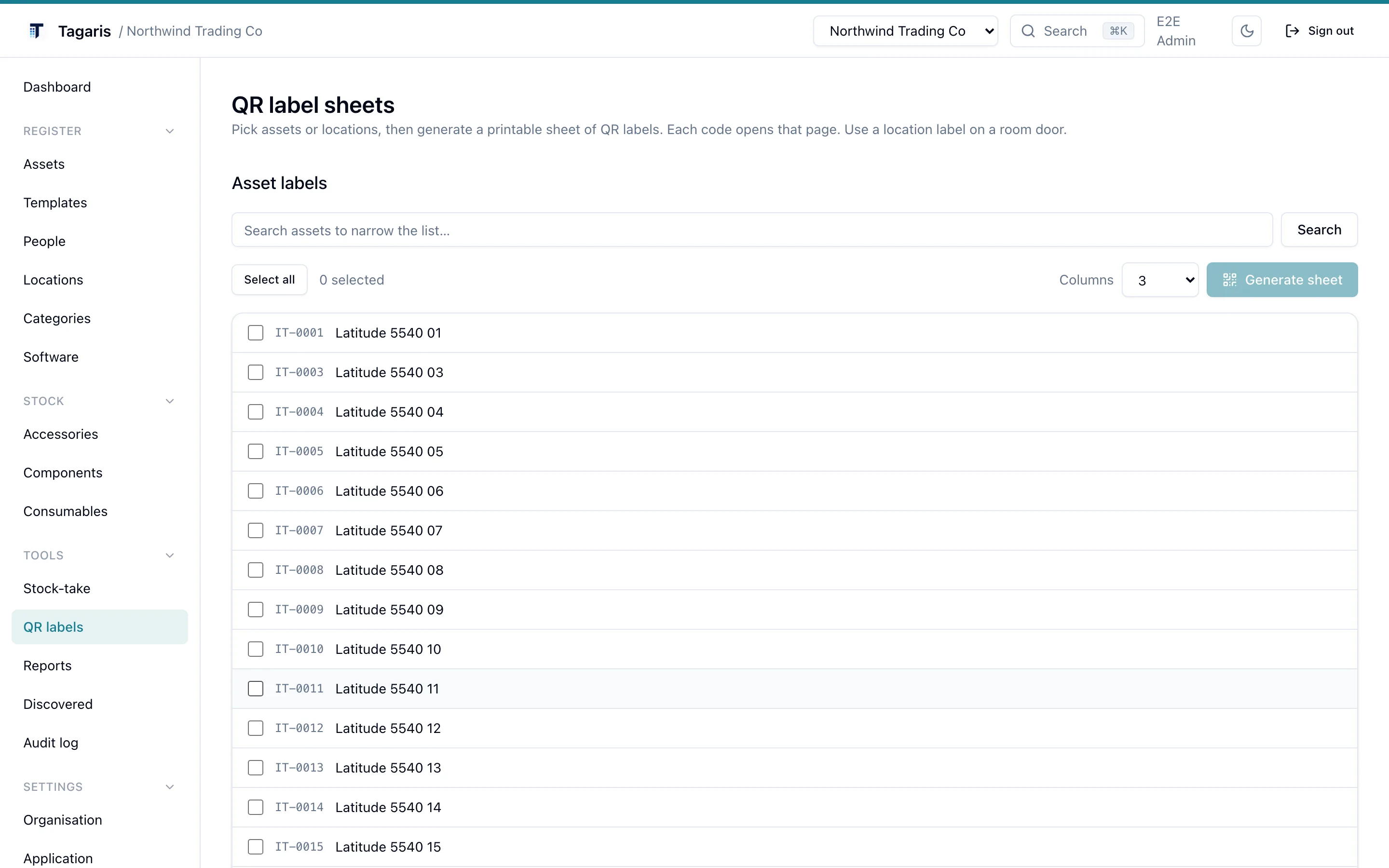
Assets belong to places at least as often as to people, so locations are first class. Pick assets or rooms and generate a printable sheet of QR labels. Each code opens that page.
Stick one on the comms room door. Scan it, see the expected kit, bulk-move the strays. A room audit stops being an afternoon job.
Scan a door, audit a room
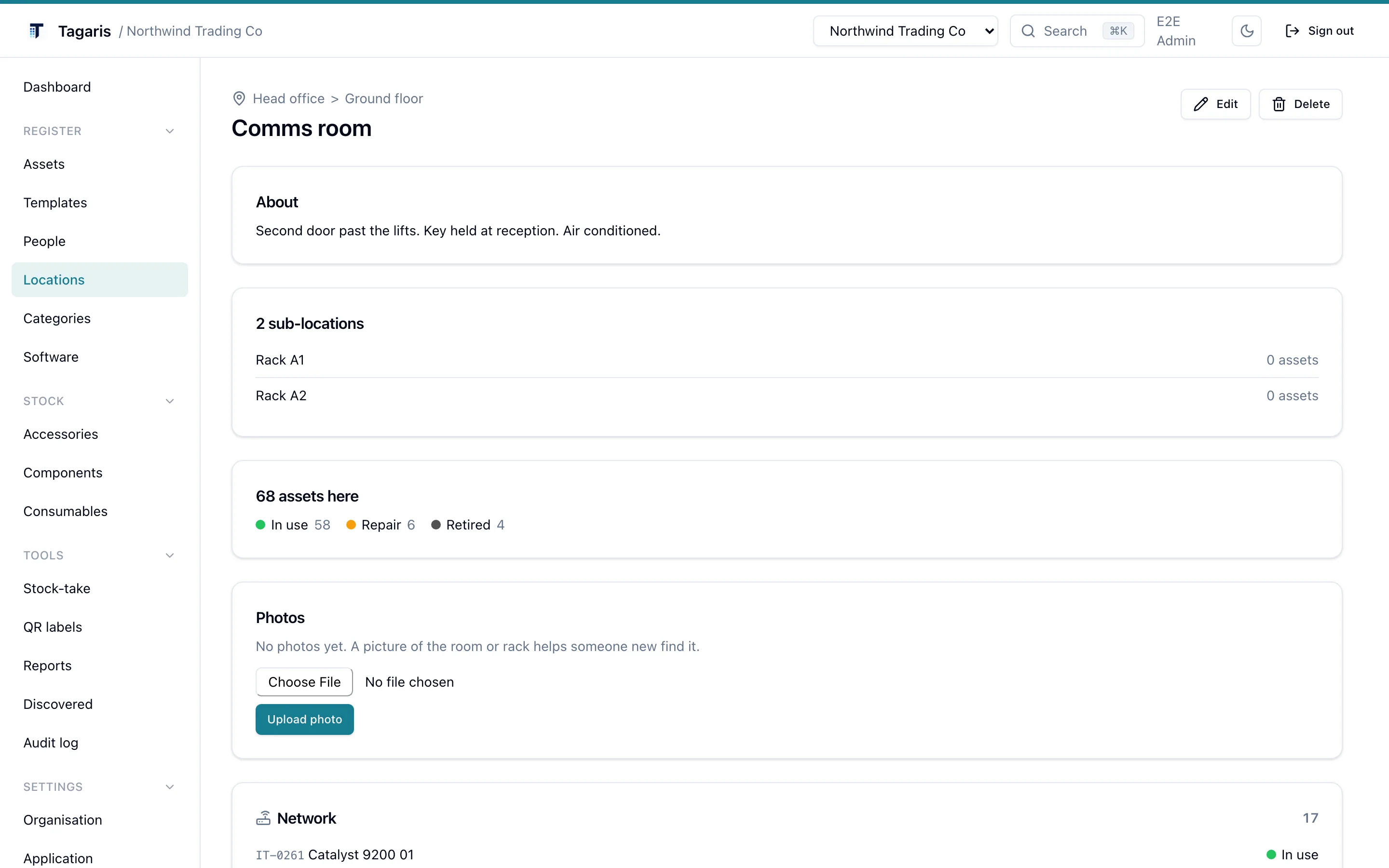
Every location has its own page listing what should be in it, grouped by category, with a status summary at the top. That is what a scanned door label opens.
Anything that has wandered off gets bulk-moved back from the assets list in one action, one history entry per asset.
Serial numbers pull their weight
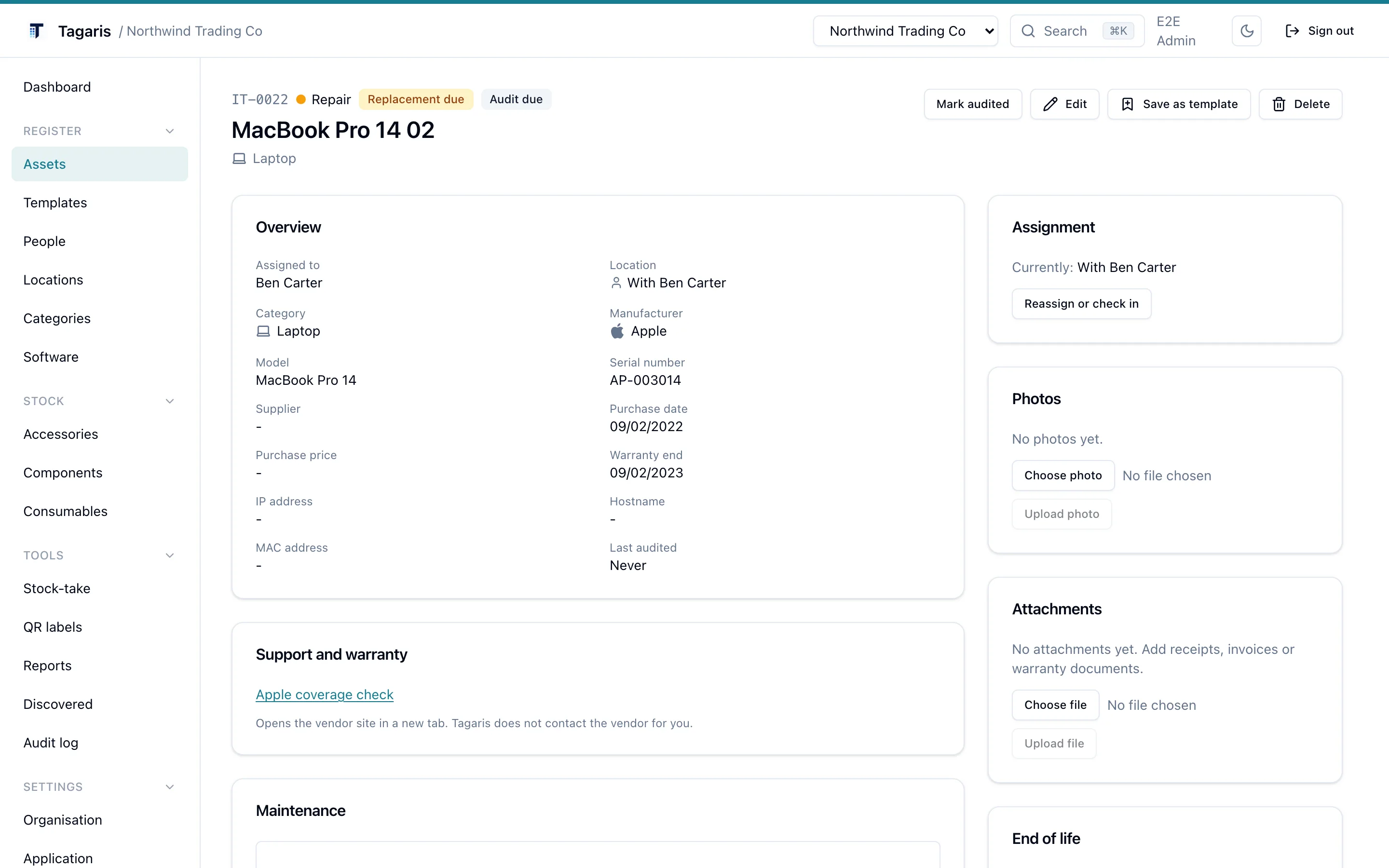
Set the manufacturer and the serial field knows what to expect: a Dell service tag is seven characters, a Lenovo serial is eight. The asset page links straight to that maker's warranty lookup for the serial you entered.
Type a known Apple model number such as A2338 and Tagaris offers to
fill in the name, model and category. All of this is local intelligence. No
third-party calls, no scraping.
- A quiet "replacement due" badge when kit passes its replacement age
- Duplicate serial and MAC warnings on create and on import
- Every change recorded in the asset's history
Group locations into buildings and sites
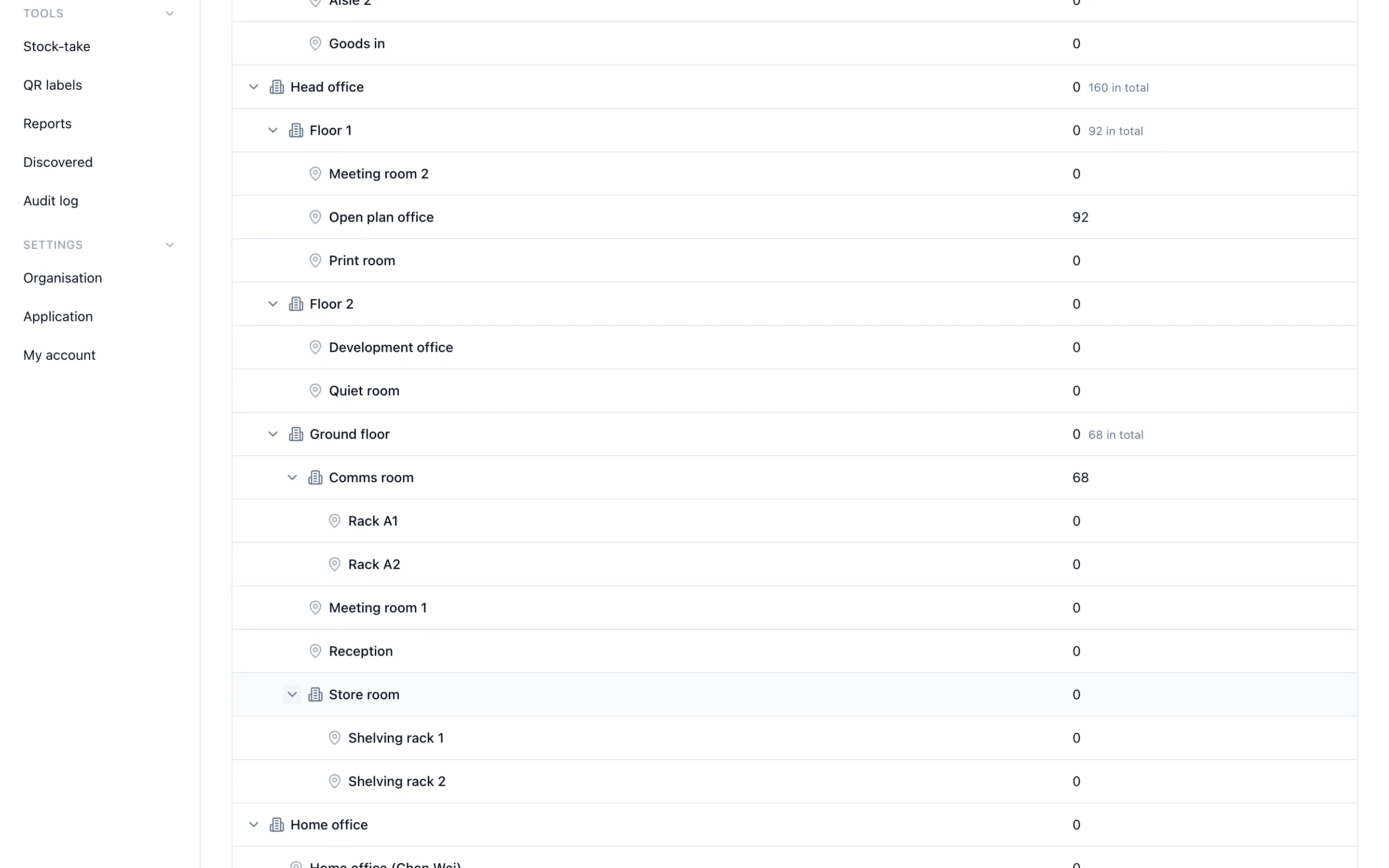
Locations form a tree. Put a building at the top, the rooms under it, and Tagaris rolls the asset counts up the branches, so a site total is one glance, not a sum.
Collapse a site you are not working on, expand the one you are, or flip to a plain A to Z list. Every room is still one click from the assets inside it.
Reports you can read, export or print
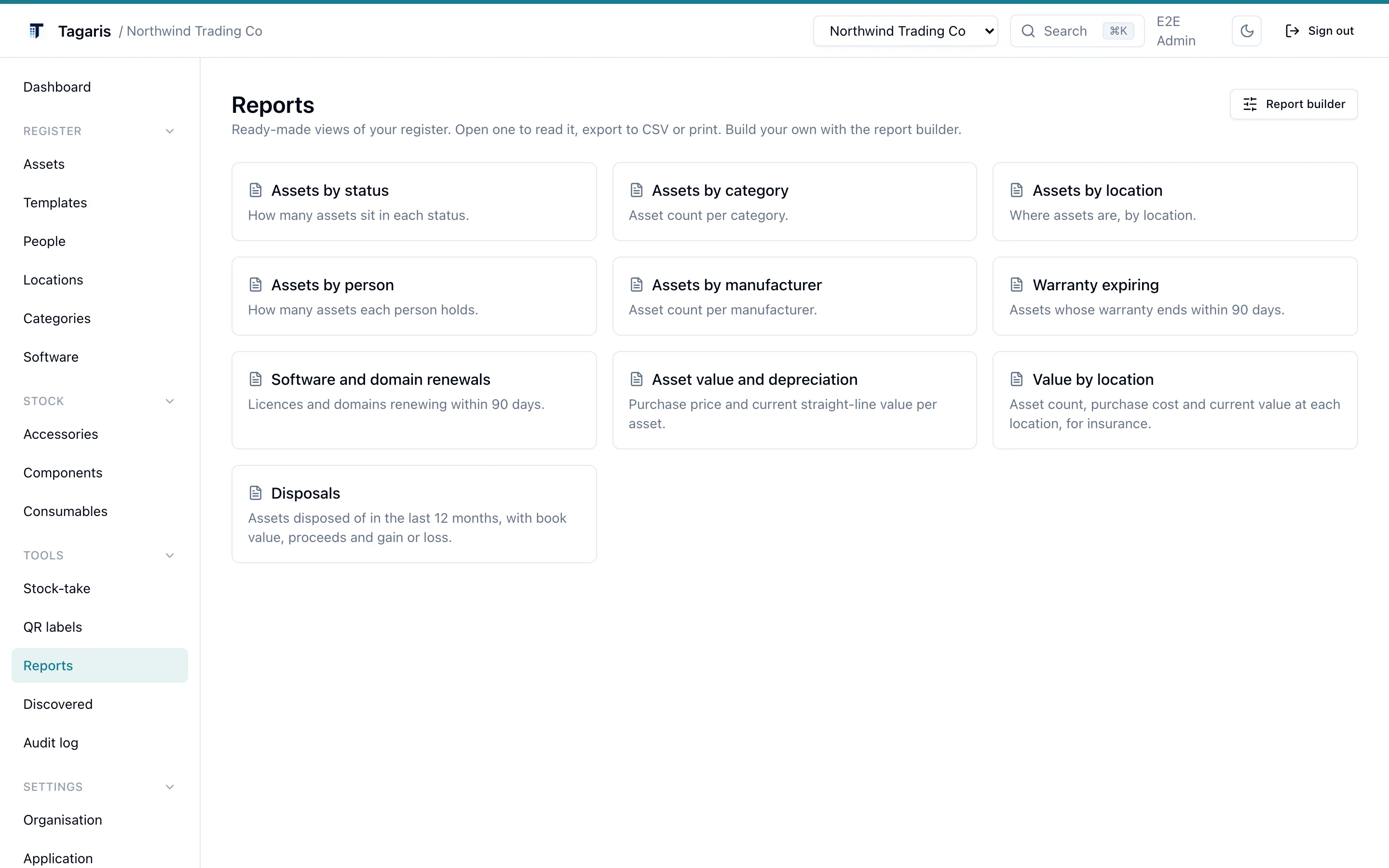
Ready-made views of the register: assets by status, category, location, person or manufacturer, warranties and licences due, and value with straight-line depreciation.
Open one to read it, export it to CSV, or print it. Need something specific? On Team plans the report builder filters the register and picks the columns.
Consumables and accessories, not just fixed assets
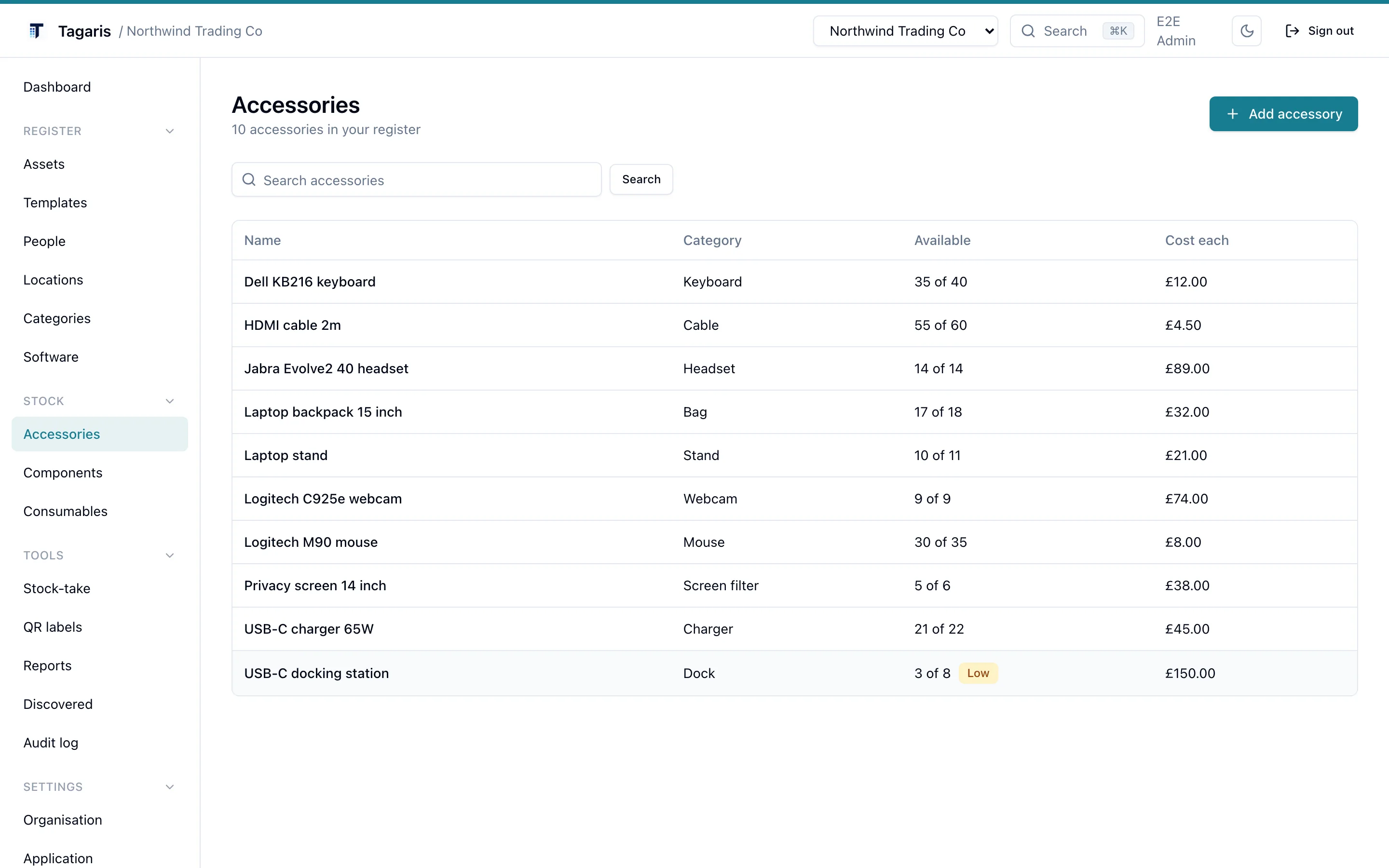
Track the stock around the estate too: accessories checked out to people, components installed into machines, and consumables that decrement as they are issued.
Each has a minimum quantity, so the daily digest flags low stock before you run out of docks, cables or toner.
The full list
Four pages go deeper: QR labels and scanning, software licences and renewals, check-out, check-in and audits and the asset lifecycle. Integrations have their own page.
The register
- Hardware, software licences, warranties and assignments in one place
- Search, filter and sort. Every asset keeps a dated history
- Assets can belong to a person, a location, both, or neither
- Check-out and check-in, recorded in the asset's dated history
- CSV import with column mapping and a dry-run preview, including a Snipe-IT preset
- Export the whole register to CSV or JSON at any time
- Printable QR label sheets for assets and for locations
- Photos, with location metadata stripped on upload, and attachments such as receipts, invoices, warranty certificates and manuals
- Starter categories, manufacturers and templates seeded on first run
- Duplicate serial and MAC warnings on create and on import
- Bulk move: select assets, pick a location, done
- Custom fields and custom status labels per organisation
Stock, money and upkeep
- Accessories, components and consumables, with low-stock alerts
- Straight-line depreciation and an asset value report
- Maintenance records and a physical audit (stock-take) workflow
- A daily email digest of renewals due and assets past replacement age
Security and operations
- Two-factor authentication for password sign-in
- Email by SMTP, Microsoft 365 or Google Workspace
- Scheduled backups with restore, optionally encrypted and copied to S3-compatible storage
On Team plans
- A documented REST API (v1) with personal and organisation keys
- Jira ticketing: raise and link tickets from asset pages, with the ticket status shown on the asset
Free beta
- Pull devices from Microsoft Intune or Jamf, and people from Microsoft Entra ID
On your phone
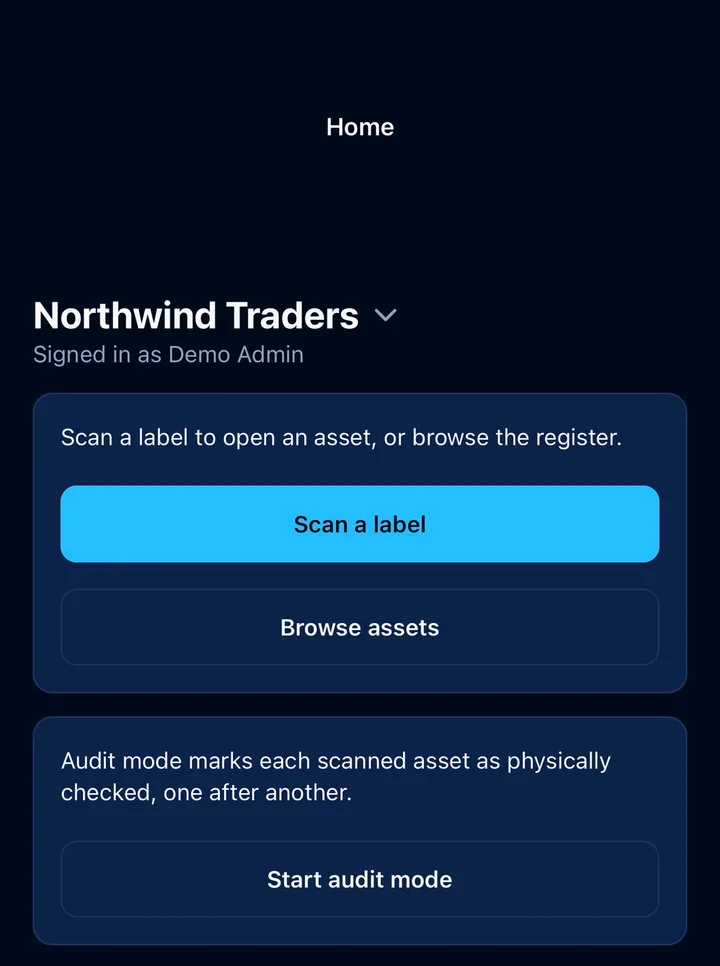
Tagaris for iOS (iPhone and iPad) pairs with your own server and signs in the same way as the browser, including two-factor and single sign-on. Scan a label to open the asset, change its whereabouts or status, log maintenance, raise a ticket, or create a new asset from an unknown serial. Audit mode walks a room label by label. It works on the free tier.

Android is in development.
The free tier is not a demo
The self-hosted tier is free and stays useful. It is not limited by the number of assets or by export, so your data is never held hostage.
What you pay for are team and compliance features, and the gate is only ever on those, never on your assets.
- Multiple users with Admin, Editor and Viewer roles
- Single sign-on through OpenID Connect (Microsoft Entra ID)
- An org-wide audit log of who changed what, with CSV export
- Custom report builder and scheduled reports
- REST API access with personal and organisation keys
- Add-on: run multiple organisations on one install
No agents, no telemetry
Tagaris is a register, not an agent. It does not scan your network or watch your machines, and it sends no telemetry. The one outbound call a self-hosted instance makes by default is a daily check for a newer version, which sends the version number and nothing else and can be switched off. Monitoring is the job of its sibling product, Fodaris.
Applying a purchased key contacts our licensing service once to activate the install. After that an annual licence is checked against nothing but its signed certificate, using Ed25519 on your own server, so it works the same on an isolated network as on the internet; air-gapped servers apply a licence file instead. A monthly subscription adds one small daily check to confirm it is still active.
Try it before you install it
The live demo runs the current release in your browser. When you are ready, the install is three commands.